Templates · Knowledge cards
Study Notes Template for Revision Sheets
This study notes template packs a whole topic onto one sheet — the core idea at the top, the definitions that have to be exact, the procedure in order, and the mistakes that lose marks — at the density you actually want the night before an exam.
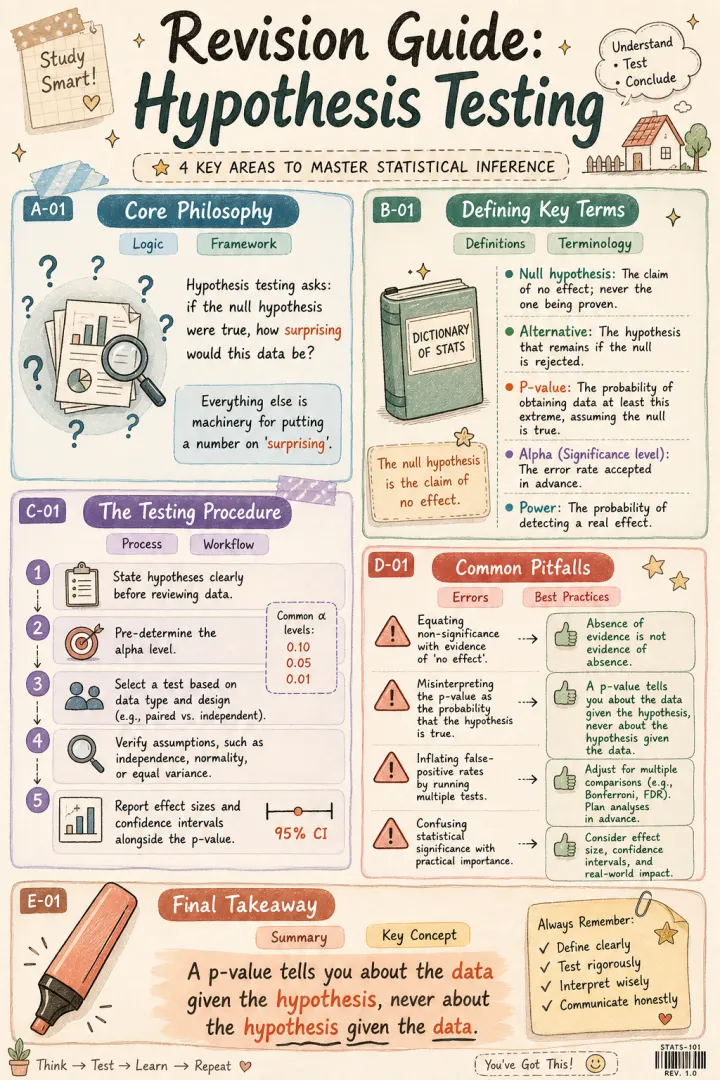
What this card carries
- The topic's central idea stated once, in a sentence, before any detail
- Definitions that are commonly confused set out separately, each with the wrong reading named
- The procedure as a numbered run, including the assumption checks people skip
- A block of the four classic errors, which is the part that survives into the exam hall
The revision notes this sheet was generated from
Revision notes — hypothesis testing
The core idea. A hypothesis test asks a single question: if the null hypothesis were true, how surprising would this data be? Everything else is machinery for putting a number on "surprising".
Definitions worth getting exactly right. The null hypothesis is the claim of no effect, and it is the one being tested — never the one being proved. The alternative is what remains if the null is rejected. A p-value is the probability of data at least this extreme assuming the null is true; it is not the probability that the null is true, and not the probability the result was chance. Significance level alpha is the error rate you accept in advance. Power is the chance of detecting a real effect of a given size, and it depends on sample size, effect size and alpha together.
The procedure. State the hypotheses before looking at the data. Choose alpha in advance. Pick the test that matches the data type and the design — paired or independent, one-tailed or two. Check the assumptions the test actually relies on, usually independence, and depending on the test, normality or equal variance. Compute the statistic and its p-value. Compare and report the effect size with a confidence interval, not the verdict alone.
The four errors that cost the most marks. Treating a non-significant result as evidence of no effect — absence of evidence is not evidence of absence. Reading p as the probability the hypothesis is true. Running many tests and reporting the one that worked, which inflates the false positive rate. Confusing statistical significance with practical importance: a trivial effect becomes significant at a large enough sample.
One line to remember. A p-value tells you about the data given the hypothesis, never about the hypothesis given the data.
Why a revision sheet should be crowded
Most visual summaries are built to be read by someone encountering the material for the first time, so they are sparse by design. A revision sheet is the opposite: you already know this, and what you need is everything in one field of view so recall is triggered by position rather than by reading.
That is why this one is dense on purpose. The modules sit close together, the type is small, and there is very little breathing room — which would be a flaw on a card meant to teach and is the point on a card meant to revise from. If it fits on one screen or one printed page, it works.
What to paste into a study notes template, and what to leave out
Paste your own notes rather than the textbook. A study notes template is built from what you supply, so the version made from your notes carries your gaps and your emphases, which is exactly what you want to be looking at a week before an exam.
Leave out worked examples. They eat the space that definitions and procedure need, and they are the one thing you should be doing rather than reading. One topic per sheet, too: a sheet covering a whole module becomes a contents page, and a contents page is not revisable.
Questions
Questions about this knowledge card template
It will try, and the result will be too small to read. One topic per sheet is the working limit — three sheets for a module beats one unreadable poster, and the set stays consistent if you generate them the same way.
Written out in words or in simple notation, usually yes. Heavy mathematical typesetting is where rendered text is least reliable, so check anything symbolic against your notes and keep the sheet for structure rather than as a formula reference.
Yes — the language of the card follows the language of your notes, and you can also set it explicitly before generating.
No — this is not a blank template you fill in, and the result is not an editable canvas. You paste the text you have already written, and Flowgraph renders it as a finished PNG. If something is wrong, change the source text or switch the style and generate again; each generation costs one credit.
Use this template with your own text
Not a blank template to fill in: you bring the writing, and this template's structure, style, aspect and palette are applied to it. What comes back is a finished image, not an editable canvas. One credit per image, and the first is free.