Templates · Knowledge cards
Deep Work Visual Notes
These Deep Work visual notes use an iceberg, because the book's argument is a claim about visibility: the work that earns social credit sits on the surface, and the work that determines whether the year amounted to anything sits underneath it.
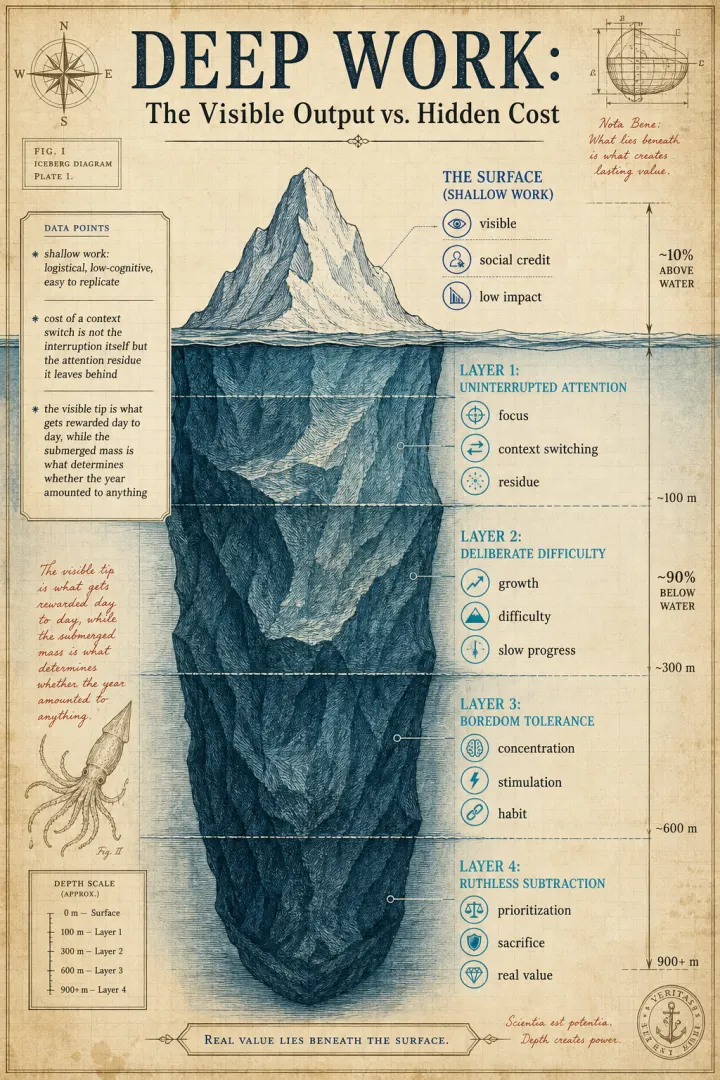
What this card carries
- Above the waterline: answered email, attended meetings, closed tickets — legible and low-value
- Below it, four hidden layers: uninterrupted attention, deliberate difficulty, boredom tolerance, ruthless subtraction
- Attention residue named as the real cost of a context switch, not the interruption itself
- The uncomfortable conclusion — the tip is what gets rewarded, the mass is what counts
The notes this card was generated from
Deep Work — visible output and hidden cost
Above the surface sits the work everybody can see. Email answered within minutes. Meetings attended. Messages acknowledged. Tasks closed. This is shallow work: logistical, low-cognitive, easy to replicate, and easy to mistake for productivity because it is so legible to other people.
Beneath the surface sits everything that actually produces value, and almost none of it is visible while it is happening.
The first hidden layer is uninterrupted attention. Deep work requires long, undivided blocks, because the cost of a context switch is not the interruption itself but the attention residue it leaves behind — part of the mind stays with the previous task for a long time afterwards.
The second layer is deliberate difficulty. Skills grow when the work sits just past current ability, which feels unpleasant and looks like slow progress from outside.
The third layer is boredom tolerance. A mind trained to reach for novelty at every idle moment cannot sustain concentration on demand, so the habit of constant stimulation quietly destroys the capacity for depth long before any specific task fails.
The fourth layer is ruthless subtraction. Depth is bought with time, and time only appears when something else is dropped — which means the real prerequisite is a willingness to be worse at the shallow work that earns social credit.
The conclusion is uncomfortable: the visible tip is what gets rewarded day to day, while the submerged mass is what determines whether the year amounted to anything.
Why these Deep Work visual notes use an iceberg
The book's core distinction is not deep work versus laziness, it is deep work versus a category of activity that looks productive from outside. Showing both at the same scale loses that asymmetry — and the asymmetry is the argument.
An iceberg encodes it structurally. A small visible tip over a large hidden mass says, before a single word is read, that most of what matters is not what is on show. The proportion is the point — which is also why it would be the wrong choice for content where nothing is actually hidden.
Where this recipe transfers
The iceberg suits any surface-versus-substance argument: visible symptoms over root causes, quoted price over total cost of ownership, the demo over the migration. If your content has a genuine hidden mass, this is the shape.
This is the most restrained of the four knowledge-card examples, and the one that survives best at small sizes — which matters if the card is going to live on a phone rather than a wall. Restraint is also the honest choice for study notes: the content is the argument, and decoration competes with it.
Questions
Questions about this knowledge card template
No. It is an independent visual summary generated from our own notes on the book's ideas, with no affiliation with or endorsement by the author or publisher.
When nothing is genuinely hidden. If all of your points sit at the same level of visibility, a grid or a list is more honest — the iceberg's proportions make a claim, and an unearned claim reads as a gimmick.
Yes, and that is the better way to use it. One card per chapter stays something you can revise from; one card for a whole book becomes a contents page with pictures. Keep the same look across the set and the chapters end up reading as one body of notes.
No — this is not a blank template you fill in, and the result is not an editable canvas. You paste the text you have already written, and Flowgraph renders it as a finished PNG. If something is wrong, change the source text or switch the style and generate again; each generation costs one credit.
Use this template with your own text
Not a blank template to fill in: you bring the writing, and this template's structure, style, aspect and palette are applied to it. What comes back is a finished image, not an editable canvas. One credit per image, and the first is free.