Templates · Knowledge cards
Atomic Habits Visual Summary & Knowledge Card Template
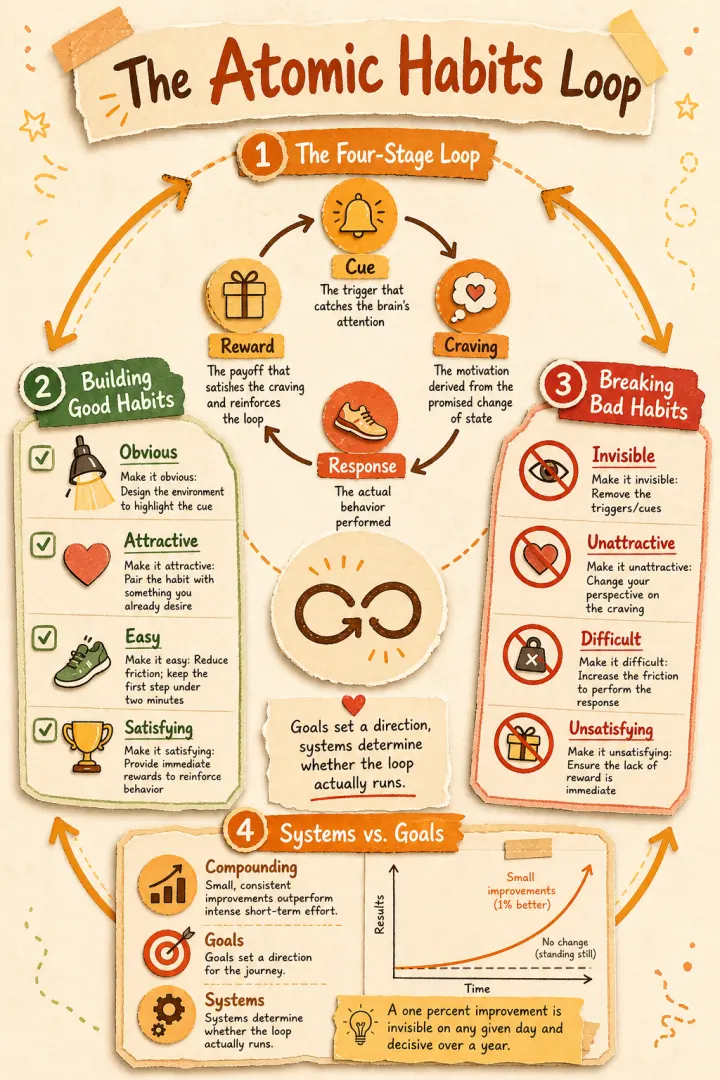
This Atomic Habits visual summary renders the book's central mechanism the way it actually behaves — as a loop rather than a list. Cue, craving, response and reward run round the ring, and each of the four laws sits on the stage it belongs to.
What this card carries
- The four-stage habit loop drawn as a closed cycle, so the reward visibly feeds back into the cue
- One of the four laws attached to each stage — make it obvious, attractive, easy, satisfying
- The inversion for breaking a habit noted against the same four stages
- The compounding claim — small margins over a long horizon — carried as the card's closing note
The notes this card was generated from
Atomic Habits — core model
Every habit runs the same four-stage loop, and the loop repeats until the behaviour becomes automatic. A cue is the trigger that makes the brain notice an opportunity. A craving is the motivation the cue produces — not a desire for the habit itself but for the change of state it promises. A response is the behaviour actually performed, which depends on how much friction stands in the way. A reward is the payoff, which both satisfies the craving and teaches the brain that this cue was worth noticing. The reward closes the loop and feeds straight back into the cue.
Each stage has a corresponding lever for building a good habit. Make it obvious: design the environment so the cue is impossible to miss, and be specific about when and where the behaviour happens. Make it attractive: pair the habit with something you already want, so the craving has something to attach to. Make it easy: reduce the friction on the response until starting takes less effort than avoiding it, and shrink the first step to two minutes. Make it satisfying: give the reward immediately, because a delayed payoff cannot reinforce a behaviour performed now.
To break a bad habit, invert all four: make the cue invisible, the craving unattractive, the response difficult, and the reward unsatisfying.
The underlying claim is about compounding rather than intensity. A one percent improvement is invisible on any given day and decisive over a year, which is why systems beat goals: goals set a direction, systems determine whether the loop actually runs.
Why this Atomic Habits visual summary is a cycle, not a checklist
The four laws are usually presented as a numbered list, which quietly loses the book's actual argument. The laws are not four separate tips; each one is a lever on a specific stage of a loop that runs continuously. Make it obvious acts on the cue. Make it attractive acts on the craving. Make it easy acts on the response. Make it satisfying acts on the reward — which is what closes the loop and teaches the brain the cue was worth noticing.
Drawn as a cycle, that structure becomes obvious at a glance and gives the card its recall handle: four stations on a ring, one lever each. As a checklist it reads as advice you either remember or don't; as a loop it reads as a mechanism you can locate yourself inside.
Making the same card from your own reading
The source text behind this image is a few hundred words of ordinary summary prose — no special formatting, no markup. That is the realistic input: the notes you would write after finishing a chapter.
Any book whose core idea is a repeating process fits this recipe directly. Where the argument is a set of parallel lessons instead, the modular grid used for the Psychology of Money card will serve better; where it is two opposed positions, the two-column contrast will.
Questions
Questions about this knowledge card template
No. It is an independent visual summary of ideas from the book, generated by Flowgraph from our own summary notes, with no affiliation with or endorsement by the author or publisher.
You can generate your own version from your own notes and use that freely — you own what you generate. For this specific example image, generate your own rather than reusing the one on this page.
No. The example was generated from a summary of the model, not from the book, and you can work the same way — paste your own notes, a chapter summary, or the four stages as you understand them. What you paste is what gets drawn, which is also why a card built from your own words is the one you will actually remember.
No — this is not a blank template you fill in, and the result is not an editable canvas. You paste the text you have already written, and Flowgraph renders it as a finished PNG. If something is wrong, change the source text or switch the style and generate again; each generation costs one credit.
Use this template with your own text
Not a blank template to fill in: you bring the writing, and this template's structure, style, aspect and palette are applied to it. What comes back is a finished image, not an editable canvas. One credit per image, and the first is free.