Templates · Knowledge cards
The Psychology of Money Visual Summary Card
This Psychology of Money visual summary uses a modular grid, because the book's lessons are genuinely parallel — behaviour over intelligence, luck and risk, enough, compounding, survival, freedom, room for error — and none of them depends on the one before it.
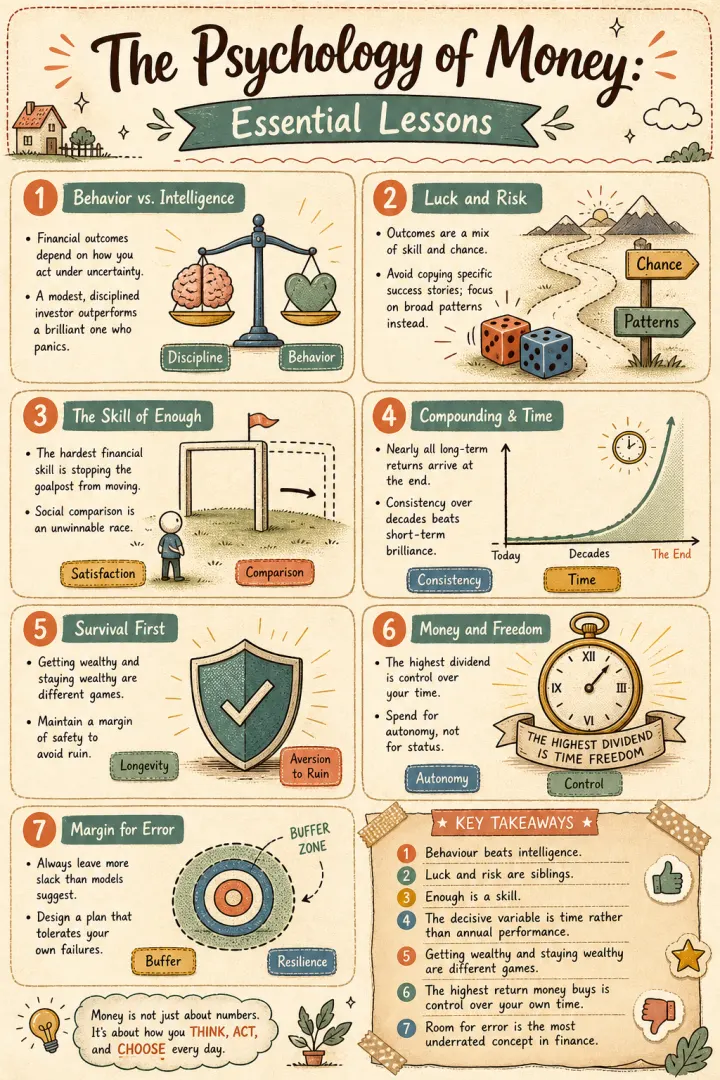
What this card carries
- Seven lessons, one numbered tile each, so they can be read in any order
- Behaviour over intelligence leads, as the claim the rest of the book rests on
- Compounding and survival set as structural ideas rather than filed as tips
- A key-takeaways panel closing the card, restating all seven in one line each
The notes this card was generated from
The Psychology of Money — lessons worth keeping
Behaviour beats intelligence. Financial outcomes are driven far more by how people behave under uncertainty than by what they know. A modest investor who never panics outperforms a brilliant one who sells at the bottom.
Luck and risk are siblings. Every outcome sits somewhere between skill and chance, and the same decision can look like genius or recklessness depending on which way the dice fell. This is why copying individual success stories is dangerous and studying broad patterns is not.
Enough is a skill. The hardest financial skill is stopping the goalpost from moving. Social comparison is a race with no finish line, and the only way to win it is to decline to enter.
Compounding is counterintuitive. Nearly all of a long-term return arrives at the end, which means the decisive variable is time rather than annual performance. Consistency that survives decades beats brilliance that survives a few years.
Survival comes first. Getting wealthy and staying wealthy are different games. Staying requires a margin of safety, an aversion to ruin, and a plan that tolerates the plan not working.
Freedom is the real dividend. The highest return money buys is control over your own time. Spending that buys status tends to be regretted; spending that buys autonomy rarely is.
Room for error is the most underrated concept in finance. Leave more slack than the model says you need, because the point of a margin is to survive the scenario you failed to imagine.
Why this Psychology of Money visual summary uses a grid
Some books are one argument developed over three hundred pages. This one is a collection of largely independent observations that happen to point the same direction. Forcing them onto a timeline or a pyramid would invent a hierarchy the text does not claim.
A modular grid says the true thing: here are several lessons, each self-contained, read them in any order. The tiles are deliberately uneven — a dense idea gets a wide tile, a one-line lesson does not sit marooned in empty space — which is what stops a grid of equal boxes from reading as a spreadsheet.
The same recipe for any lesson-shaped book
Most business and non-fiction titles are lesson-shaped, which makes this the most reusable of the four knowledge-card recipes. Paste your chapter notes and the grid re-flows around however many lessons you actually have.
The register is deliberately closer to a reader's notebook than a corporate deck, because a card about money habits gets revisited in private rather than presented. If you are making these for a team or a class, a soberer look carries the same content without looking like someone's diary.
Questions
Questions about this knowledge card template
No. It is an independent visual summary generated from our own notes on the book's ideas, with no affiliation with or endorsement by the author or publisher.
It follows your text. Five to nine reads well; beyond that the tiles get too small to hold a real thought, so trim the notes rather than the type size.
Messy is fine. Repetitive is the problem. The tiles come from distinct claims in your text, so rough notes that make seven separate points still produce seven tiles — while notes that circle the same idea seven times produce one thin card no matter how long they run.
No — this is not a blank template you fill in, and the result is not an editable canvas. You paste the text you have already written, and Flowgraph renders it as a finished PNG. If something is wrong, change the source text or switch the style and generate again; each generation costs one credit.
Use this template with your own text
Not a blank template to fill in: you bring the writing, and this template's structure, style, aspect and palette are applied to it. What comes back is a finished image, not an editable canvas. One credit per image, and the first is free.