Templates · Executive summaries
Weekly Status Report Template (One-Pager)
This weekly status report template gives every part of the update its own panel — shipped, in progress, blocked, the numbers, next week, and what you need from other people — so the blocked items and the asks stop being the paragraphs nobody scrolls to.
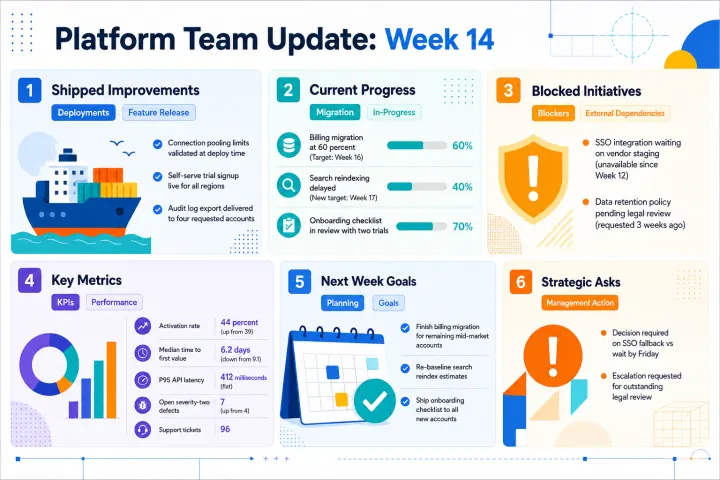
What this card carries
- Shipped and in progress kept apart, so "nearly done" cannot be read as done
- Blocked items with what they are waiting on and who owns the unblock
- A numbers panel carrying the direction of travel, not just this week's value
- An asks panel that states the decision needed and the date it is needed by
The written update this page was generated from
Weekly team update — week 14, platform team
Shipped this week. Connection pooling limits are now validated at deploy time, closing the last action from the March outage. Self-serve trial signup went live for all regions after two weeks at ten percent. Audit log export shipped to the four accounts that asked for it.
In progress. The billing migration is at 60 percent of accounts moved, on track for completion in week 16. Search reindexing is running behind: the backfill is slower than modelled and now expected in week 17 rather than 15. Onboarding checklist redesign is in review with two accounts trialling it.
Blocked. The SSO integration is waiting on the vendor's staging environment, unavailable since week 12 with no committed date. This is the second slip and it now threatens the enterprise deal timeline. Data retention policy is waiting on a legal review requested three weeks ago.
Numbers. Activation rate 44 percent, up from 39. Median time to first value 6.2 days, down from 9.1. P95 API latency 412 milliseconds, flat. Open severity-two defects: 7, up from 4. Support tickets 96, of which 31 concern the old billing flow and should disappear with the migration.
Next week. Finish the billing migration for the remaining mid-market accounts. Re-baseline the search reindex with the measured throughput rather than the estimate. Ship the onboarding checklist to all new accounts if the two trials hold up.
Asks. A decision on whether to keep waiting on the SSO vendor or build the fallback ourselves — two engineer-weeks either way, and the deal timeline needs an answer by Friday. An escalation on the legal review.
The weekly update's real failure mode
Weekly updates are rarely wrong; they are unread. Written as prose in a channel, the good news comes first because it is easiest to write, and the two things that actually needed a reader — the blocker and the decision — sit at the bottom of a message that got scanned for ten seconds.
Panels remove the ordering problem. Every section is visible at once, so a blocker cannot be buried by placement, and an ask with a date on it is as prominent as the wins. The same content, laid out so the parts that need action are the parts that get seen.
Why a weekly status report template works better as a recurring format
The payoff comes in week four, not week one. Once the panels are always in the same places, readers stop learning the page and start reading it — they know where the numbers live and go straight there. A prose update re-teaches its own structure every week.
It also makes the update cheap to produce, which is what keeps it happening. Paste this week's notes in whatever state they are in, generate, post. There is no deck to update, no template file to find, and nothing to re-type — which matters because the update that gets skipped is always the one that felt like effort.
Questions
Questions about this executive summary template
Yes. The sections hold at any cadence — the only thing that changes is how much sits in each panel. For a quarter, trim to what a reader who has not been following would need rather than concatenating twelve weeks.
The images you generate are yours and are not published anywhere by Flowgraph. As with any hosted tool, apply your own organisation's rules about what goes into one — if the update carries figures you would not paste into an external service, take them out first.
Yes. Set your exact colour and it holds across every update you generate, so a run of weekly pages looks like one series rather than a different design each Friday.
No — this is not a blank template you fill in, and the result is not an editable canvas. You paste the text you have already written, and Flowgraph renders it as a finished PNG. If something is wrong, change the source text or switch the style and generate again; each generation costs one credit.
Use this template with your own text
Not a blank template to fill in: you bring the writing, and this template's structure, style, aspect and palette are applied to it. What comes back is a finished image, not an editable canvas. One credit per image, and the first is free.