Templates · Executive summaries
Product Launch Roadmap Template (Visual Card)
This product launch roadmap template draws four phases as a route with gates between them — alpha, closed beta, launch readiness, general availability — and attaches to each the specific risk it exists to retire.
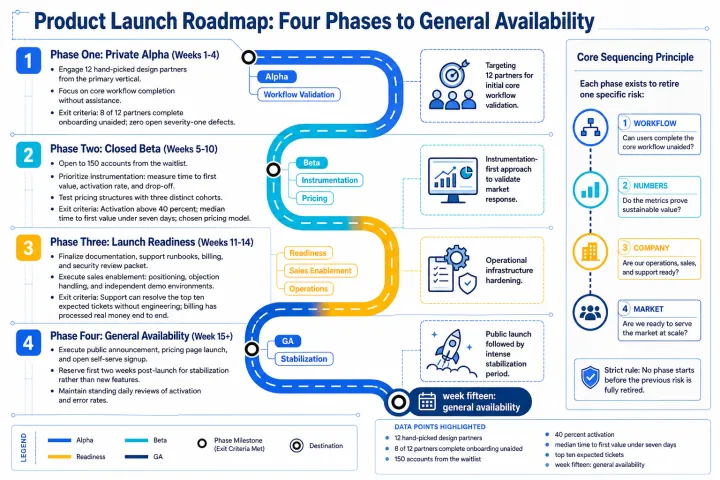
What this card carries
- Four phases along a route with weeks attached, so the shape of the plan is visible
- Exit criteria on every gate, stated as numbers rather than intentions
- The sequencing principle: no phase starts before the previous risk is retired
- Two weeks after launch reserved for stabilisation rather than new features
The launch plan this card was generated from
Product launch roadmap — four phases to general availability
Phase one, weeks one to four: private alpha. Twelve hand-picked design partners, all from the primary vertical. Goal is not feedback volume but whether the core workflow completes without assistance. Exit criteria: eight of twelve partners complete onboarding unaided, and no open severity-one defects.
Phase two, weeks five to ten: closed beta. Open to 150 accounts from the waitlist. Instrumentation lands first — time to first value, activation rate, and drop-off by step — because the beta exists to produce numbers, not anecdotes. Pricing is tested here with three cohorts on different structures. Exit criteria: activation above 40 percent, median time to first value under seven days, and a chosen pricing model.
Phase three, weeks eleven to fourteen: launch readiness. Documentation, support runbooks, billing, and the security review packet all complete before any marketing commitment. Sales enablement runs in parallel: positioning, objection handling, and a demo environment that does not depend on staging. Exit criteria: support can resolve the top ten expected tickets without engineering, and billing has processed real money end to end.
Phase four, week fifteen: general availability. Public announcement, pricing page live, self-serve signup open. The first two weeks after GA are deliberately reserved for stabilisation rather than new features, with a standing daily review of activation and error rates.
The sequencing principle throughout: each phase exists to retire one specific risk — does the workflow work, do the numbers work, does the company work, does the market respond — and no phase starts before the previous risk is actually retired.
Why this product launch roadmap template is drawn as a route
Most launch plans are drawn as a Gantt chart, which communicates duration and hides dependency. The interesting question about a launch plan is not how long phase two runs, it is what has to be true before phase three is allowed to start.
Drawing it as a route with stations makes the gates structural. Each phase has exit criteria — eight of twelve partners onboard unaided, activation above 40 percent, support resolving the top ten tickets without engineering — and the visual makes it awkward to skip one, which is precisely the failure a launch plan exists to prevent.
One risk per phase
The sequencing principle behind this example is worth stealing whatever you draw it with: each phase retires exactly one class of risk. Does the workflow work. Do the numbers work. Does the company work. Does the market respond.
Written that way, the plan explains itself and the exit criteria stop being arbitrary. Put that logic in your source text and it comes through onto the card, because the card is generated from the reasoning rather than from a list of dates.
- Product and feature launches
- Migration and rollout programmes
- Onboarding or curriculum paths
- Any plan whose phases have real gates
Questions
Questions about this executive summary template
Yes. Whatever weeks, quarters or phase names are in your text land on the route. The example uses week ranges because gates are easier to argue about than calendar dates.
Four to eight stops sit comfortably along the route. Beyond that the stations crowd and the gates stop being individually readable.
Yes — anything that is a sequence with gates. A migration, a hiring plan, a course, an onboarding programme. The one thing it needs from your text is what has to be true before each step starts; a list of phases with no exit criteria draws as a tidy line with nothing holding it up.
No — this is not a blank template you fill in, and the result is not an editable canvas. You paste the text you have already written, and Flowgraph renders it as a finished PNG. If something is wrong, change the source text or switch the style and generate again; each generation costs one credit.
Use this template with your own text
Not a blank template to fill in: you bring the writing, and this template's structure, style, aspect and palette are applied to it. What comes back is a finished image, not an editable canvas. One credit per image, and the first is free.