Templates · How-to guides
How-To Guide Templates
A guide fails at the point where the reader cannot tell what to do next. Below are two finished how-to guide templates — a staged checklist and a long-range roadmap — each generated from an ordinary written process, and each reusable with your own.
2 step-by-step guides, generated and shown in full
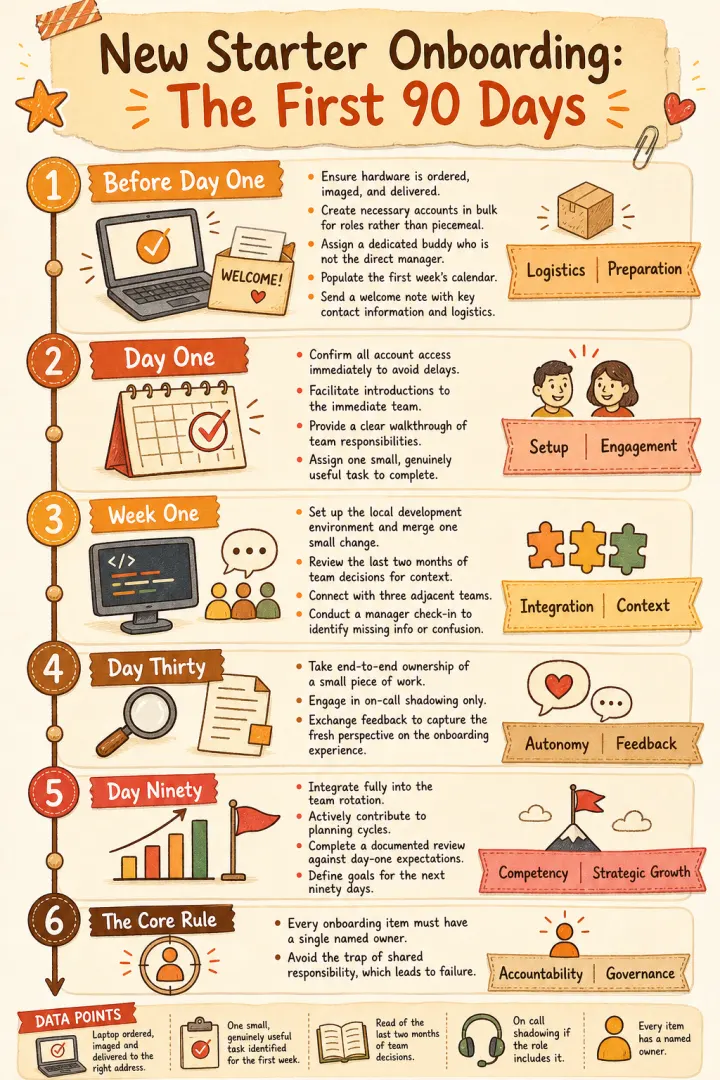
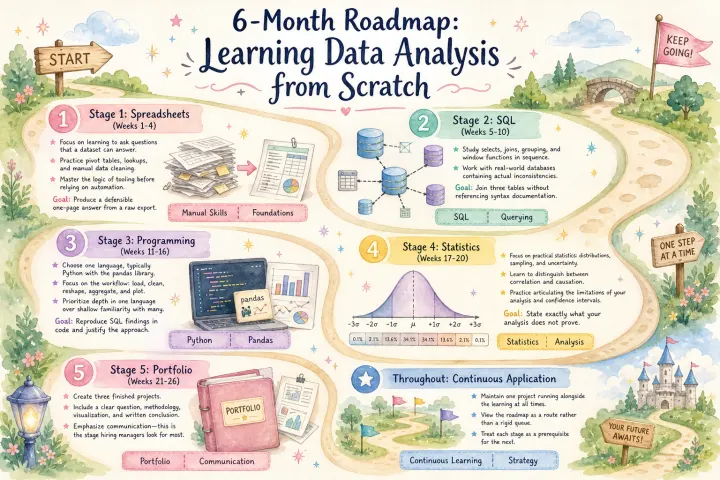
Why written processes get abandoned halfway
A process written as prose hides its own shape. The reader cannot see how many steps remain, which ones are prerequisites and which are optional, or where they currently are — so the document gets skimmed once, half-followed, and never opened again. The information was all there; the structure was not.
Drawn as a sequence, the same content answers those questions before it is read. Length is visible, order is visible, and the reader can locate themselves on it. That is why an onboarding checklist on a wall gets used and the same checklist in a wiki page does not.
A checklist and a roadmap are not the same thing
A checklist is short-range and complete: every item will be done, most of them soon, and the value is in not forgetting any. A roadmap is long-range and conditional: the stages are ordered because each is the prerequisite for the next, and the honest version says what has to be true before you move on rather than pretending to know the dates.
Choosing wrongly is the common failure. A ninety-day plan drawn as a flat checklist implies everything is equally near, and a five-item task list drawn as an epic journey looks like padding. Match the drawing to the horizon.
- Steps that all get done, in order → a straight sequence
- Stages with a gate before the next one → a route with stops
- A process that returns to its own start → a closed cycle
- A decision the reader has to make first → branches
What your source text needs to contain
The one thing a guide needs and most drafts lack is the exit condition — what has to be true before this step is finished. Without it a sequence draws as a tidy line with nothing holding it up, and the reader still cannot tell whether they are ready to continue.
So write the steps as prose, in order, and add the condition to each one. That single addition is what separates a guide someone can follow unaided from a list of headings, and it is the part no template can supply for you.
Questions
Questions about how-to guide template
Four to eight is the comfortable range, and it holds for both shapes. Beyond that the steps get too small to carry a real instruction — the fix is to group them into stages and let each stage list its own items.
Yes. If the last step feeds the first, say so in your text and it draws as a loop rather than a line, which is the honest shape for anything cyclical — a review cadence, a habit, a sprint.
No. Ordinary prose in the right order works. Numbering helps and is not required; what matters far more is that each step says what has to be true before the next one starts.
Yes — downloads are full-resolution PNGs with no watermark, and upright suits a wall or a page. A staged checklist on a wall is where this format earns its keep.
Elsewhere on Flowgraph
Make one from your own text
Pick the example closest to what you are summarising and paste your content — the recipe comes with it.