Templates · How-to guides
Learning Roadmap Template
This learning roadmap template draws a six-month plan as a route with five stops, and puts a condition on each one — what you should be able to do before moving to the next — which is the part a list of topics never tells you.
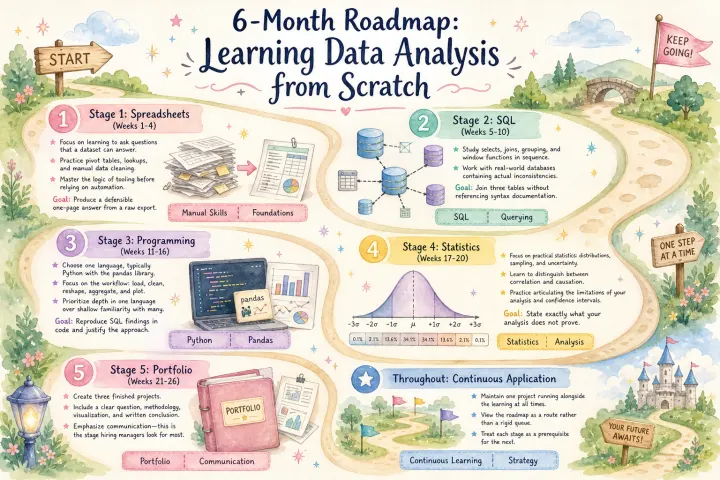
What this card carries
- Five stages in the order the prerequisites actually run, with weeks attached
- A move-on condition under each stage, stated as a capability rather than a chapter
- The stage most self-taught learners skip called out rather than left implicit
- A standing instruction that runs across the whole route, not inside any one stage
The plan this roadmap was generated from
Six-month roadmap — learning data analysis from scratch
Stage one, weeks one to four: spreadsheets and questions. Before any code, learn to ask a question a dataset can answer. Pivot tables, lookups, cleaning a messy export by hand. The point of doing it manually first is that it teaches what the tooling is automating later. Move on when you can take a raw export and produce a defensible one-page answer to someone else's question.
Stage two, weeks five to ten: SQL. Selects, joins, grouping, window functions, in that order. Work against a real database with real inconsistencies rather than a teaching dataset that has been cleaned for you. Move on when you can answer a question that requires joining three tables without looking up the syntax.
Stage three, weeks eleven to sixteen: one programming language, properly. Python with pandas is the common route. Load, clean, reshape, aggregate, plot. Resist collecting libraries; depth in one beats familiarity with six. Move on when you can reproduce your SQL answers in code and explain which approach suits which problem.
Stage four, weeks seventeen to twenty: statistics that actually get used. Distributions, sampling and uncertainty, correlation against causation, the handful of tests you will genuinely run, and how to read a confidence interval out loud. Move on when you can state what your analysis does not prove.
Stage five, weeks twenty-one to twenty-six: communication and a portfolio. Three finished projects, each with a question, a method, a chart someone else can read, and a written conclusion. This is the stage most self-taught analysts skip and the one hiring managers read first.
Throughout. One project running alongside the learning at all times. The roadmap is a route, not a queue — the stages are ordered because each one is the prerequisite for the next, not because the previous one is finished.
A topic list is not a plan
Most learning plans are a list of subjects in a plausible order. They tell you what to study and nothing about when you are done with it, so the learner either moves on too early and struggles for reasons they cannot diagnose, or stays too long polishing something that was already sufficient.
A route with gates says the missing part out loud. Each stop carries a capability — answer a question that needs three joined tables without looking up the syntax — and that sentence does more for a self-taught learner than the reading list above it. It is also what makes progress visible when motivation runs out around month three.
Using this learning roadmap template for your own subject
The subject in this example is data analysis, but a learning roadmap template holds for anything learned in dependency order: a language, an instrument, a certification, a career change, an onboarding curriculum for a team. Write your stages as prose with the weeks and the move-on condition, and paste it.
If you are publishing a roadmap for other people — a course outline, a community guide, a mentoring plan — the same image does the work a long post cannot. Readers decide whether a six-month commitment is realistic by looking at its shape, and the shape is not visible in paragraphs.
Questions
Questions about this how-to guide template
Four to eight stops read comfortably. More than that and the stops crowd until the conditions stop being individually readable, which removes the only thing that made it a roadmap rather than a list.
Yes — whatever your text says is what gets drawn. For a self-study plan, durations tend to survive contact with reality better than fixed dates, which is why this example uses week ranges.
That is one of the better uses. Learners judge whether a plan is feasible by its shape, and a route with visible gates answers that in a glance where a syllabus does not.
No — this is not a blank template you fill in, and the result is not an editable canvas. You paste the text you have already written, and Flowgraph renders it as a finished PNG. If something is wrong, change the source text or switch the style and generate again; each generation costs one credit.
More How-to guides
Use this template with your own text
Not a blank template to fill in: you bring the writing, and this template's structure, style, aspect and palette are applied to it. What comes back is a finished image, not an editable canvas. One credit per image, and the first is free.