For students, teachers, trainers & note-takers
A Knowledge Card Generator for Notes, Lectures & Transcripts
Most of what you need to remember never arrives as a tidy document. This is a knowledge card generator for the other kind of material — the notes you typed during a lecture, the transcript of a talk, the write-up nobody edited — and it turns that into a single card with a shape you can recall.
Before / after
The same content, twice
What you have
A page of notes in the order they were said
Lecture 4 — what "knowing it" actually means
Six levels, each built on the one under it. Revision that stays in the bottom two feels productive and predicts almost nothing about the exam.
Remember — produce the term without the page in front of you. The floor, not the goal. Understand — say it in your own words to someone who has not done the reading…
Evaluate — say when the method fails, and why the alternative was rejected. Examiners live here. Create — put two things from different weeks together…
What comes back
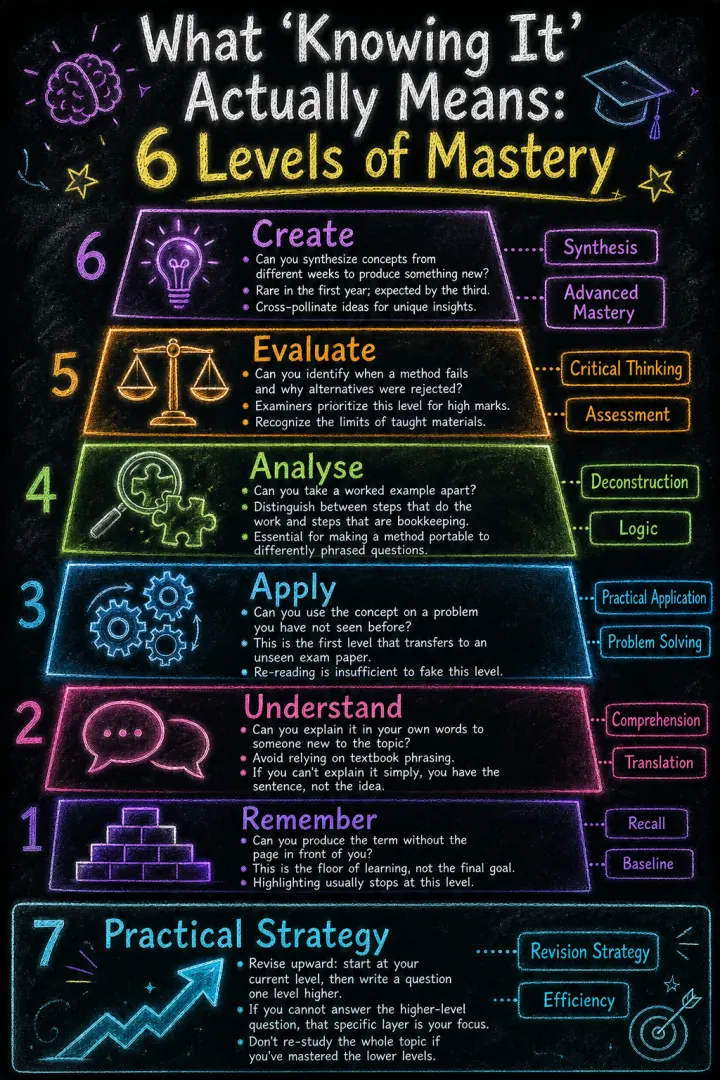
One upright card, built to be recalled
- The six levels stacked, so the dependency between them is visible
- Each level keeps its test question — the thing that makes it checkable
- The bottom two marked as the floor, which is the lecture's actual point
- One idea per card, so the next lecture becomes the next card, not more of this one
The notes you took are not notes you can revise from
Notes taken live are a recording, not a summary. They follow the order the speaker happened to use, they are longest where you were most confident, and they go silent at exactly the moment the hard thing was explained. Reading them back six weeks later mostly reminds you that you were there.
Turning them into something revisable is real work, and it is the same work every week. You have to find the claim the lecture was actually built around, separate the mechanism from the worked example, and decide which four things hang off it — then draw that, legibly, before the next lecture's notes land on top.
So the notes stay as notes. They get re-read, which feels like studying and behaves like reading, and the structure that would have made them stick is never extracted from them at all.
Finding structure in material that has none
A paper hands you its skeleton: there is an abstract, the sections are named, the argument is signposted because it was written to be followed. Notes and transcripts hand you nothing, and that absence is the first thing a knowledge card generator has to solve. The claim might be in the third bullet, the mechanism might be an aside, and the sentence that made everything click was probably never written down because you were busy understanding it.
So the first thing that happens is a reading pass over the whole of what you pasted, looking for the load-bearing claim rather than the first one. What it finds determines the structure — a hub with spokes when several factors hang off one mechanism, stacked layers when each thing depends on the one under it, a loop when the last step feeds the first. The shape is a consequence of your material, which is why the same generator produces very different cards from a lecture on memory and a lecture on cash flow.
You can make this considerably easier in about thirty seconds. Before pasting, put the claim at the top in one sentence, even if it was said last. Delete the housekeeping — the reading list, the reminder about the deadline, the two minutes about the room change. Keep every number exactly as it was given. None of that is required, and all of it improves the card more than any setting will.
Four shapes, and how to tell which one your material wants
Cards that survive have a shape you could describe out loud, and there are only a few that do real work. Knowing which one your notes are asking for is most of the skill, and it is decided by the content rather than by taste.
The failure to watch for is a card with no centre. If everything on it is the same size and importance, you have made a decorated list, and a list is what memory handles worst — which is the thing your original notes already were.
- One mechanism with several factors hanging off it → a centre with spokes
- Each thing depends on the one below it → stacked layers, read bottom-up
- The last step feeds the first → a closed loop
- Two positions in opposition → a split card, one side each
One card is a member of a set
A single card is a nice object; a term's worth of them is a study system, and the difference between the two is consistency. A knowledge card generator earns its keep on the twentieth card rather than the first, because cards made one at a time — each with whatever look seemed right that week — do not read as a set. You lose the ability to glance at a wall of them and know where you are, which was much of the point.
Settle the look once, on the first card, and reuse it. Because it is a setting rather than design applied by hand, the twentieth card matches the first without anyone maintaining a template. The same is true for a team's reference cards or a trainer's handouts: what makes them usable is that they are visibly the same series.
Keep to one idea per card and let the set grow instead. A card holding three independent arguments fails the moment any one of them is shaky, exactly as a study card with three facts on it does. If the lecture made three points, that is three cards — and three cards is a better week's revision than one crowded diagram.
When a card is the wrong answer
A knowledge card is for material somebody has to hold in their head. If nobody needs to recall it — they need to act on it, or be persuaded by it — a different output does the job better, and there is no sense making a beautiful card that the situation was never going to reward.
- A report someone has to make a decision from → a one-pager, framed for a cold reader
- Something going into a feed to be read at thumb speed → carousel cards
- A document you have not read yet, rather than notes you took → distil the PDF directly
How to do it in about a minute
- 01
Paste the notes, however rough
You can make knowledge cards from notes in whatever state they came out — lecture notes, a transcript, a meeting write-up, bullets. Put the main claim at the top if you can; it is the one edit worth thirty seconds.
- 02
Check the shape it came back in
This page starts you with an upright card and one idea at the centre. If your material is really a cycle or an opposition, switch the structure rather than rewriting the text.
- 03
Generate, then keep the settings
The card arrives in about a minute as a watermark-free PNG. Reuse the same settings next week and the term's cards end up looking like one set.
Questions
Questions about knowledge card generator
The input. That page starts from a finished document you have to get through — a paper, a chapter, a book — and distils it. This one starts from material that was never a document: notes in the order they were said, a transcript, a write-up. Same output, different problem to solve before you can produce it.
Yes, and transcripts are one of the better inputs precisely because they are long and unstructured — there is a lot for it to throw away. Filler and false starts are ignored. What hurts is a transcript with the numbers garbled, since figures are read exactly as written.
One idea. The useful test is whether you could describe the card's shape out loud — one mechanism with four factors, two positions opposed, a loop that closes. If you cannot, it is holding more than one idea and wants to be two cards.
If you reuse the settings, yes. The look is a setting rather than hand-applied design, so a set stays coherent without anyone keeping a template up to date. That is what makes a wall of them scannable.
Yes. You own what you generate and can hand it out, print it, or put it in a deck, including commercially. Full-resolution PNG, no watermark — though as with any generated summary, check a card against your source before a room full of people does.
Generate a knowledge card
Paste your own text and the settings from this page are already applied. A free credit covers the first one.